News
Dikili Tash and the 50th anniversary of the Del Duca Foundation
Published on : 02.02.2026![]()
Anthropomorphic figurine with incised decorationThe Dikili Tash team was invited to participate in the making of the documentary "A Life's Work," produced to mark the 50th anniversary of the Simone and Cino Del Duca Foundation. In this documentary, P. Darcque recounts the circumstances under which the Greek-French mission of Dikili Tash, under the auspices of the Archaeological Society at Athens and the French School at Athens, was awarded the 2020 Great Prize of Archaeology of the Simone and Cino Del Duca Foundation – Institut de France, and the major contribution of the prize to the mission's activities from 2021 to 2024. The documentary is available online on the Simone and Cino Del Duca Foundation website (for the Great Prize of Archaeology, see from 24:32 to 26:11 minutes).
See the page : A Life's Work
Excavation campaign 2024
Published on : 02.02.2026![]()
Terracotta spoon with an anthropomorphic handleA new campaign took place in July-August 2024 at Dikili Tash in sector 9, on the northern slope of the tell, with the participation of some forty people: archaeologists, students, and workers from Greece, France, and Bulgaria.
Excavation revealed a layer common across the southern three-quarters of the area, probably a leveling layer. Three superimposed layers of plaster were seen underneath. The northern limit of the leveling layer is marked by a linear depression, possibly a pre-existing ditch, which served as a refuse area during part of the Late Neolithic II period (4800-4200 BC). The area provided large quantities of finds: bones, shells, ceramic vessels, figurines, ornaments, and tools made of various materials.
Additional cleaning of the three large pits filled during the Early Bronze Age II (2800-2500 BC), allowed us to establish that their walls were made of branches, clay, and stones, using a technique never before attested in Northern Greece or the surrounding regions.
Excavation campaign 2023
Published on : 21.01.2026![]()
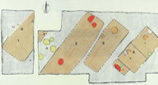
The areas excavated in 2023A new six-week campaign took place at Dikili Tash in July-August 2023, more precisely in sector 9, on the northern slope of the tell. Some forty people participated, archaeologists, students, and workers from Greece, France, and Bulgaria.
The continuation of House 9-B was uncovered in the southwest area beneath the last remains of House 9-A. It includes the remains of a thermal structure, probably a hearth. In the southeast area, a layer of stones and pottery sherds was discovered, from which five parallel rows of posts emerged. This seems to be a structure that would have supported a raised platform/floor.
The connection between the north and south part of the sector is interrupted by the presence of three large Early Bronze Age pits, which proved to be much deeper and richer than expected and are still not fully excavated.
Le temps et ses noms. Construire une chronologie égéo-balkanique du 7e au 4e millénaire avant J.-C., 2025
Published on : 21.01.2026![]()
Zoï Tsirtsoni, co-director of the Dikili Tash project, has just published, in the collection Bibliothèque des Écoles françaises d’Athènes et de Rome (BEFAR), a book of more than 500 pages about the relative and absolute chronology of the long period — about 3,500 years — known in Greece as the “Neolithic.”
Designed for archaeologists specializing in the Aegean and Balkan prehistory, as well as for anyone interested in the measurement of time, dating methods, and the integration of chronological data into historical narratives, the new scheme proposed — reliable and easy to use — offers a shared standard for the entire corpus, which should prove equally valuable to other disciplines (geography, natural sciences, genetics) engaged in large-scale modeling.
See the page : French School at Athens editions
> See the archived news